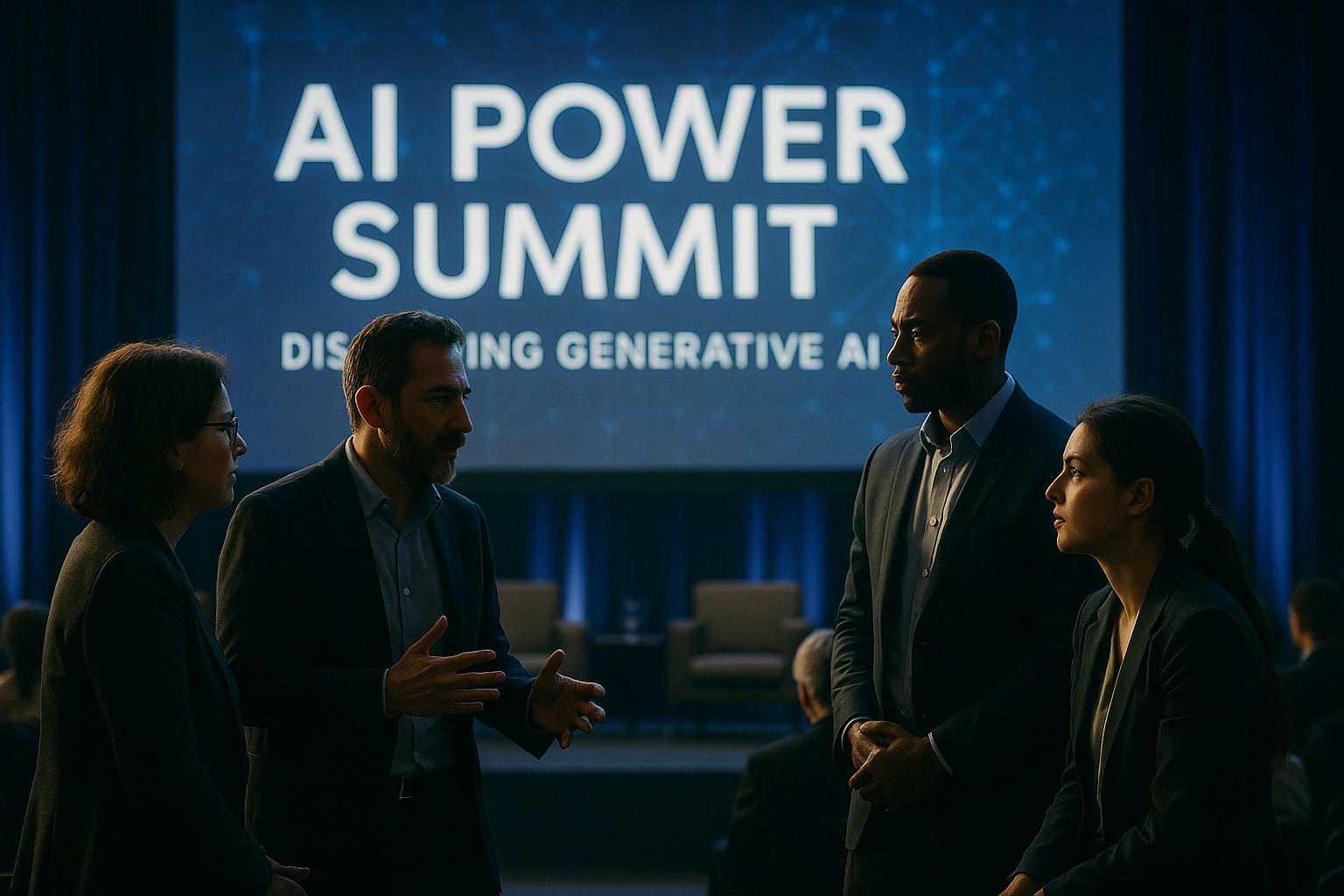
AI Power Summit: Harnessing Generative AI and Future Trends with Technology Leaders
Introduction
The AI Power Summit 2025 concluded as one of the most pivotal gatherings in recent tech history, where the world’s leading thinkers, developers, and executives assembled to explore the remarkable potential of generative AI. As artificial intelligence continues to redefine industries and reimagine innovation, events like the AI Power Summit are imperative in establishing collaborative paths forward.
This year’s summit was especially focused on the intersection of generative AI technologies, insights from technology leaders, and unfolding future trends. With cutting-edge discussions on AI-generated content, algorithmic creativity, machine learning applications, and ethics in automation, the summit highlighted the convergence of ingenuity and responsibility. The central theme made it clear: we are only at the beginning of a new technological epoch, and united leadership will shape its trajectory.
Background
To understand the significance of the AI Power Summit, it’s critical to first grasp how generative AI has evolved into the transformative force it is today. From GPT-powered chatbots to image-generating models like DALL·E and real-time voice synthesisers, generative AI is no longer confined to experimental labs; it is embedded in daily workflows, commerce, education, and even the creative arts.
The AI Power Summit, first launched in 2018, has grown in scale and reputation, evolving alongside the technology it showcases. Initially focused on general approaches to machine learning and deep learning, the summit has increasingly emphasized future trends and collaborative innovation. Now, with its clear mission to act as a nexus for progress, it draws top technology leaders from companies like Google, OpenAI, Meta, Microsoft, and startups that are pushing the envelope.
Collaboration remains at the heart of this event. As AI becomes more complex and widely applied, alignment between academia, industry leaders, policymakers, and ethical boards is crucial. Much like a symphony orchestra where each musician contributes to the harmony, advancing AI requires unified efforts—and the AI Power Summit acts as that global conductor.
Current Trends
This year’s summit explored several key trends in generative AI, presenting case studies and real-world applications that are already delivering impact:
– AI-Generated Media: Industry players revealed advancements in AI-generated music, video, and 3D design. For example, Runway ML showcased a tool capable of producing commercial-grade motion graphics from text prompts—a revolution for the entertainment and marketing sectors.
– AI in Healthcare: A keynote from Mayo Clinic’s Chief Information Officer detailed how AI models are improving diagnostic accuracy and reducing burnout by generating patient summaries in real-time.
– Ethically Aligned Design: Consensus across panels emphasized safer AI outputs by integrating ethical guardrails, transparency, and bias mitigation during model training.
These developments illustrate how technology leaders are shaping AI to solve both macro-challenges—infrastructure, climate change, misinformation—and micro-applications like automating administrative tasks.
A compelling example came from Amazon’s use of generative AI to design warehouse routes, improving logistics efficiency by 27%. Just as GPS changed travel forever, generative AI is set to transform specialized workflows across sectors.
As WIRED Magazine’s summit coverage noted, “2025 marks a turning point for AI not just innovating, but becoming indispensable.”
Insights from Technology Leaders
At the heart of the AI Power Summit were the voices of technology leaders—CEOs, researchers, and developers who offered not just opinions but hands-on stories of implementing AI responsibly and creatively.
Sundar Pichai, CEO of Alphabet, emphasized scalability and access:
> “The goal isn’t to create AI for a few; it’s to create AI for billions and give them the tools to innovate.”
Fei-Fei Li, Co-Director of Stanford’s Human-Centered AI Institute, challenged attendees to consider humanity at the center of innovation:
> “We must design AI systems not as replacements, but as amplifiers of human ability and dignity.”
Another important takeaway came from OpenAI’s CTO Mira Murati, who highlighted the symbiosis of humans and generative models:
> “The best results come when AI supports human creativity—not competes with it.\”
These insights underscored the summit’s philosophy: AI is a co-pilot, not an autopilot. It should empower, not overshadow. Challenges remain—data privacy, algorithmic bias, model hallucinations—but collaborative leadership across disciplines can address these with foresight and intention.
Future Forecasts
Looking toward the horizon, the future trends discussed during the summit were both visionary and pragmatic. Among the most compelling predictions:
– Decentralized AI Infrastructure: With growing concern over monopolized model access, startups hinted at a shift toward federated models built on open-access protocols.
– Multimodal Integration: Future generative models will seamlessly combine text, audio, image, and motion capabilities, enabling real-time storytelling across formats.
– Regulatory Frameworks: As AI intersects with public policy, governments are anticipated to collaborate more deeply with industry to establish ethical legislation around model development and deployment.
Additionally, edge computing and low-power AI chips are expected to democratize access to high-functioning generative AI on mobile and embedded devices, especially in education, agriculture, and disaster relief.
An analogy one speaker used painted a powerful picture: If traditional algorithms are calculators, generative AI is a collaborator—one that brainstorms, drafts, and iterates alongside you. That vision of machine-human partnership is central to the next phase of digital evolution.
Call to Action
Whether you’re a student, developer, executive, or policymaker, now is the time to become part of the conversation the AI Power Summit is leading. Generative AI is no longer a buzzword—it’s a reshaping force of our digital lives.
Here’s how you can stay engaged:
– Attend Future Summits: Visit the official AI Power Summit website for updates on next year’s registration, speaker lineups, and global satellite events.
– Follow the Conversation: Join forums, read thought pieces, and follow innovators on platforms like LinkedIn and GitHub to stay ahead of vital future trends.
– Learn and Experiment: Leverage open-source AI tools and educational resources to build your understanding—be it through courses, coding sprints, or AI challenges.
As the lines blur between the imagined and the automated, staying informed is no longer optional—it is essential. The AI Power Summit doesn’t just showcase what’s possible; it encourages everyone to take part in shaping what comes next.
—
Related Articles:
– What Generative AI Means for the Future of Work
– The Rise of Multimodal AI: Where Text, Image, and Sound Converge
Citations:
– WIRED: AI Power Summit 2025 Coverage
– MIT Technology Review: Future of AI Innovation