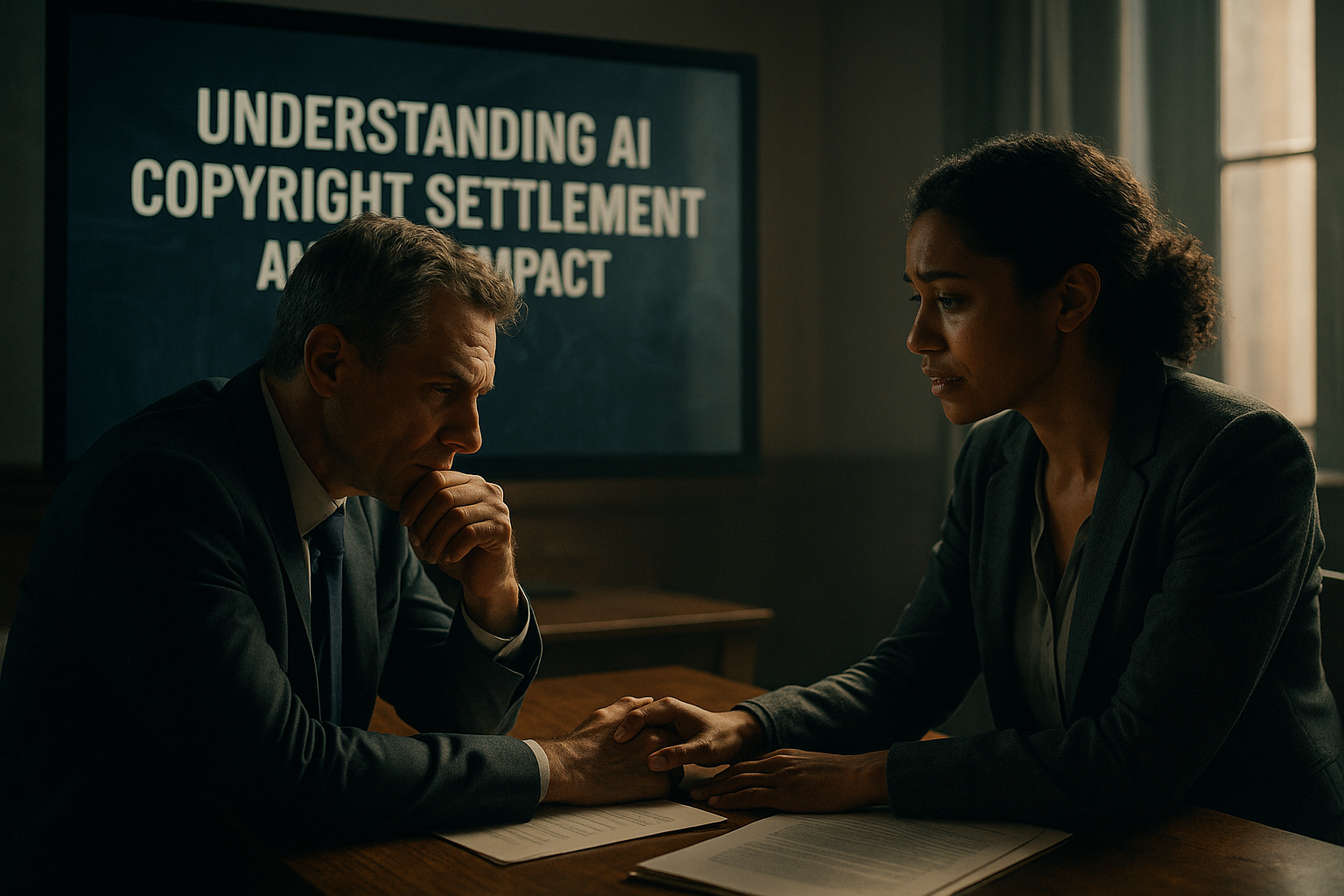
AI Copyright Settlement: Understanding the Evolving Landscape
Introduction
The rapid rise of generative artificial intelligence (AI) technologies has disrupted numerous industries—from creative arts and publishing to legal and digital content creation. At the heart of this technological transformation lies a contentious and complex issue: the AI Copyright Settlement.
As AI systems grow more sophisticated, they rely on vast datasets—often scraped from publicly available content—to optimize performance. This practice has led to an unresolved debate over intellectual property rights, artist compensation, and legal boundaries. For authors, this presents new challenges: how can one protect their original work when it might be used, without consent, to train a language model?
The AI Copyright Settlement represents a pivotal moment in this conversation. It directly addresses the tension between innovation in AI training and the protection of author rights. As companies such as Anthropic and others work toward resolution, it’s vital for creators, technologists, and legal professionals to stay informed about these ongoing developments and their implications.
In this post, we’ll explore the foundations, trends, and future of the AI Copyright Settlement—understanding how it’s reshaping the intersection between AI and intellectual property across industries.
—
Background
The concept of artificial intelligence \”learning\” from human-created text and data has been around for years. However, the line between AI training and copyright infringement became a major flashpoint with the rise of large language models such as ChatGPT, Claude by Anthropic, and others.
Publishers and authors began to question whether their digital works—books, articles, blogs—were being used without explicit permission to train these models. As reported by Wired, lawsuits and negotiations culminated in settlements, such as the one between Anthropic and several major book publishers, including Penguin Random House and HarperCollins. The core issue: whether using copyrighted material to train generative AI constitutes fair use or piracy (source).
Key players in this evolving discourse include:
– Anthropic: An AI company developing Claude, which has been directly involved in recent copyright settlement negotiations.
– Authors Guild: A leading advocacy group pushing for the protection of author rights in the face of generative AI.
– Tech companies: Firms such as OpenAI, Meta, and Google have all encountered legal scrutiny for how they train their models.
The analogy of AI as a sponge helps illustrate the debate. Imagine soaking up countless pages of literature to form patterns of speech and knowledge—without knowing whether the sponge skipped the \”Do Not Copy\” warning. This spongelike learning, while powerful, walks a legal and ethical tightrope, especially when the content comes from copyrighted books or articles.
As these cases unfold, they illuminate a deeper truth: our copyright system is still playing catch-up with AI capabilities. The AI Copyright Settlement is essentially a recognition that traditional frameworks may no longer suffice in this era of synthetic content creation.
—
Current Trends
In reaction to increasing legal pressure, AI companies are revisiting how they collect and use training data. The emerging trend is clear: training practices are shifting toward greater transparency and rights compliance.
Among the steps companies are taking:
– Licensing agreements: Firms like Anthropic are entering into financial settlements and licensing deals with publishers, allowing them to use content legally for AI training.
– Open-source and public domain content: More AI models are being trained on data that is explicitly non-copyrighted, reducing legal risk.
– Opt-out mechanisms: Platforms are creating ways for content creators to request exclusion from training datasets.
Moreover, global regulators are beginning to chime in. In the EU, for instance, the AI Act will likely enforce stricter compliance on data sourcing and model transparency. AI copyright settlements in the U.S. are indirectly influencing these protocols by pushing companies to preemptively align with stricter legal expectations.
From a business perspective, compliance with intellectual property laws isn’t just a legal obligation—it’s becoming a competitive advantage. Companies that can promise ethically sourced models will find wider industry acceptance and fewer courtroom distractions.
This trend underscores a growing realization: the golden age of AI experimentation must now coexist with legal accountability. Companies are learning that innovation without ethical safeguards can be both reputationally and financially costly.
—
Insights
To better understand the long-term impact of the AI Copyright Settlement, it’s essential to consider expert perspectives from both the legal and creative communities.
Authors’ Perspective: Many writers worry that their livelihoods are being undermined. If AI can mimic their voice or generate similar work, why would readers pay for the original? As Mary Rasenberger, CEO of the Authors Guild, told Wired, \”Authors should be compensated if their work is used to train AI—it’s that simple.\” (source)
Technologists’ Perspective: On the technology side, some leaders argue that limiting access to written material stifles innovation. They advocate for a “fair use” interpretation, especially when data is used not to reprint the original but to learn language patterns. However, many are now recognizing that models trained on ethically sourced data can still be competitive and more sustainable.
Legal Scholars: Intellectual property experts argue that these settlements could push toward new precedent. The current laws, crafted for books, music, and art—not algorithms—must evolve. Some theorize we might see a classification system where training data is tagged and paid for, much like how music licensing works in broadcasting.
Each insight points to the same conclusion: the AI Copyright Settlement is less of a finish line and more of a starting point for a necessary, multifaceted restructuring of how we view intellectual labor in the AI era.
—
Forecast
Looking ahead, the AI copyright conversation is set to become more intricate, and the recent settlements—like the one involving Anthropic—will be seen as milestones shaping future regulations.
What can we expect?
– Increased regulation: Governments and international bodies may implement definitive policies requiring that AI developers pay to license creative content used in training.
– Rights tracking technologies: Blockchain or watermarking systems may be developed to trace full or partial use of content within AI models.
– Creator-centric platforms: New platforms or tools may emerge, allowing authors and artists to monetize their works in AI ecosystems, opting in on their terms.
This trajectory could significantly rebalance the rights dynamic between authors and AI developers. Rather than fearing AI as a disruptive threat, creators could view it as an amplification tool—provided they’re fairly compensated and acknowledged.
Long-term, the AI industry might resemble the music streaming business: content creators receive micropayments or licensing fees for each time their content is used in training, generating a steady income stream. It may not completely close the gap, but it can create a more equitable ecosystem.
—
Call to Action
The landscape of AI copyright enforcement is evolving daily. Whether you’re a creator, technologist, or legal professional, understanding the implications of the AI Copyright Settlement is essential.
To stay informed:
– Subscribe to industry newsletters: Track developments from outlets like Wired, TechCrunch, and legal analysis blogs.
– Follow advocacy groups: Organizations like the Authors Guild and Electronic Frontier Foundation offer updates and insights.
– Support transparency in AI: Advocate for rights-conscious AI practices, especially when leveraging intellectual property in model development.
The intersection of AI and intellectual property is not a niche concern—it’s a defining issue of our digital future. By staying educated and engaged, we influence how this future unfolds for all stakeholders.
—
Related Articles:
– Wired: Anthropic Agrees to Pay Publishers for Use of Copyrighted Books
– The Atlantic: AI Is Training on Journalists’ Work. And It’s Feeding ‘Black Box’ Technology
Keywords used: AI Copyright Settlement, Anthropic, author rights, AI training, intellectual property.