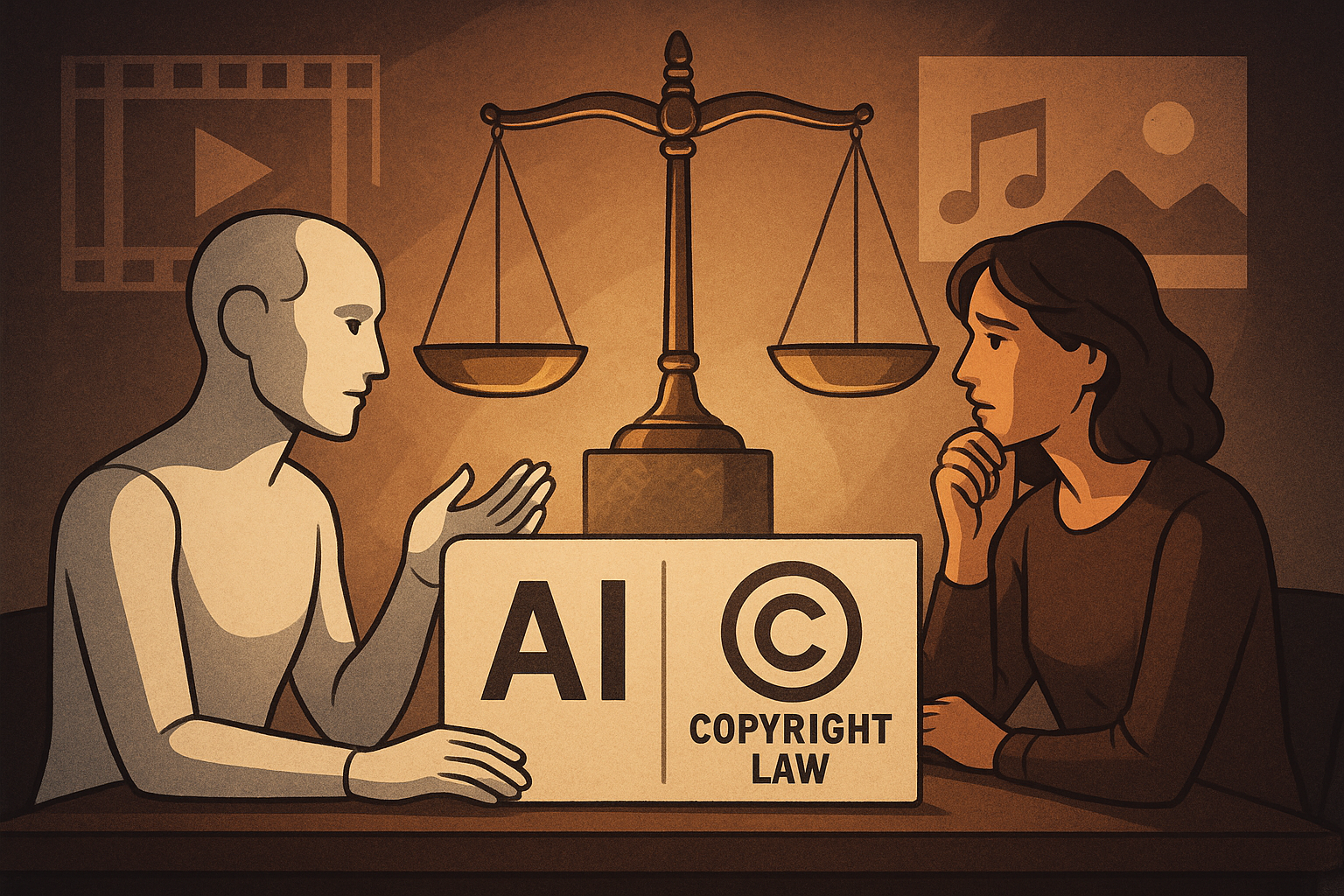
AI Media Copyright: Navigating the Evolving Landscape of Copyright Laws in the Age of AI
Introduction
As artificial intelligence (AI) continues to shape modern life, one of the most complex legal and ethical battlegrounds it influences is media copyright. AI media copyright refers to the protections—or lack thereof—that govern content created or mediated by AI systems. In a digital economy where content is currency, understanding how copyright laws apply to AI-mediated content is crucial for creators, tech companies, regulators, and the general public alike.
Traditionally, copyright laws have been designed to protect human creativity—music, literature, video, or art produced by an individual or team. Now, with machines generating articles, deepfakes, music remixes, and synthetic images, we face new questions: Who owns AI-generated media? Can a machine be an author? What happens when an AI replicates copyrighted material?
This emerging intersection raises immediate challenges for intellectual property rights and media ethics. As AI blurs the boundaries between original and replicated content, stakeholders must navigate a transformative yet uncertain legal landscape. In this article, we delve into the historical context, current debates, and potential futures of AI media copyright.
Background
To appreciate the challenges in AI media copyright, it’s crucial to understand the historical foundation of copyright law. Established centuries ago to protect the livelihood of authors, musicians, and artists, copyright principles have continually evolved in tandem with technological change—from the printing press to the internet.
At the core of copyright is the idea of intellectual property rights: creators are granted exclusive rights over their original works, encouraging innovation by ensuring fair compensation. These rights not only reward creativity but also serve as a framework for cultural and economic production.
Enter artificial intelligence. Over the past decade, AI’s role in media creation has shifted from auxiliary tool to prolific creator. Text generation models can write novels. Generative adversarial networks can create photorealistic images from scratch. Music-generating algorithms compose symphonies within seconds. These examples challenge the traditional notion of authorship.
Unlike human creators, AI lacks consciousness or intention, complicating the attribution of rights. Take, for instance, the AI-generated artwork that won first place at the Colorado State Fair in 2022—an image crafted by Midjourney AI and submitted by a human user. While the human input was indirect, the artwork was distinctly machine-made. Who, then, is the rightful copyright holder?
As AI becomes deeply integrated into creative workflows, these once-hypothetical questions now require urgent legal and ethical examination.
Current Trends in AI Media Copyright
One of the defining characteristics of this new era is the explosion of AI-generated content, which has upended traditional copyright practices. From AI-crafted articles on news platforms to deepfake videos depicting celebrities saying things they never did, the lines between original and derivative works are increasingly blurred.
Multiple high-profile copyright disputes have surfaced, highlighting the underlying tensions. In 2023, a class-action lawsuit filed against OpenAI and Microsoft accused the companies of using copyrighted material without permission to train AI models—a move authors claimed devalued their works source.
Another case involved artists alleging that their original artworks were scraped to train AI diffusion models without compensation or recognition—an act they likened to plagiarism at digital scale. As one analogy suggests: If a museum secretly photocopied art and distributed it globally, no one would question the copyright breach. Yet that’s essentially what’s happening in AI training today.
These issues have forced a reassessment of media ethics. Who is accountable when AI systems generate defamatory or misleading content? What responsibilities do developers, platforms, and users carry?
Moreover, AI-produced works present new enforcement challenges. Unlike human creators who may copyright and register their content, AI systems can mass-produce media in seconds, making unauthorized distribution and identification nearly impossible to monitor.
Industry insiders argue that the evolution is inevitable and that we must adapt. However, this requires robust frameworks that reconcile AI capabilities with ethical media use and creator rights.
Insights from Industry Experts
Legal scholars, AI developers, and policy specialists are engaged in an ongoing dialogue about balancing creative innovation with content protection. Experts agree that striking the right balance between AI innovation and copyright protection is paramount.
Dr. Anne Harrison, a professor of intellectual property at NYU Law, notes: “The law was not designed for non-human creators. What we need now are statutory definitions that reflect AI’s role—not ignore or overregulate it.”
Several strategies are emerging:
– Hybrid authorship models where human inputs to AI systems (prompt engineering, editing, curation) are recognized for copyright purposes
– Transparency requirements in AI training datasets to ensure content was sourced ethically and legally
– Creative Commons-style licenses for artists to opt in or out of having their works used for AI training
According to Leila Mendoza, counsel for a large entertainment company, \”Clarity is missing. Developers need to know what’s allowed, artists need protection, and consumers need confidence that content is authentic.\”
Indeed, the U.S. Copyright Office has begun updating its guidelines. In 2023, it released a new policy stating that copyright protection applies only to the portions of works that involve human creativity—a partial step toward acknowledging AI-mediated content without granting AI the status of legal author.
Yet, ambiguity remains a common complaint. With inconsistent international standards and rapidly evolving AI capabilities, legal certainty feels elusive.
Future Forecast: The Evolution of Copyright in AI Media
As AI continues its exponential growth, legislative and regulatory efforts must evolve to address complex questions around authorship, ownership, and fairness in AI media copyright.
Future developments are likely to include:
– International harmonization of copyright laws to provide a cohesive framework for content used and distributed across borders
– New legal categories of AI-generated works, recognizing them as distinct from purely human-authored or derivative works
– Regulatory AI audits to verify ethical training and usage of copyrighted materials, possibly enforced by organizations such as the Copyright Office, FTC, or EU’s AI Act
In the long term, consumer demands may dictate policy change. As audiences become more sophisticated and value “authentic” vs. “synthetic” content, platforms may adopt new labeling and licensing mechanisms. The expectation for transparency and ethical AI might become as essential as data privacy is today.
Moreover, as AI-generated content becomes indistinguishable from that of humans, the enforcement of copyright may depend on blockchain-based provenance tools and watermarking technologies.
The future of AI media is not only technical; it is profoundly human. It will depend on our collective decisions about transparency, fairness, and the value of creativity—however it is created.
Call to Action
In a rapidly evolving media landscape, staying informed is an ethical and strategic necessity. Whether you’re a creator, technologist, consumer, or policymaker, understanding AI media copyright is vital.
– Subscribe to publications covering advancements in AI and copyright law.
– Follow organizations like the Electronic Frontier Foundation, Creative Commons, and national copyright offices for updates.
– Join the conversation by commenting below: Do you believe AI-generated works should be copyrighted? Who should own creative content produced by machines?
– For further reading, check out related articles like Google accused of stealing content, or explore emerging legislation in the EU AI Act.
Despite the ambiguity, one thing is clear: how we define and enforce copyright in the age of AI will determine the future of creativity itself.